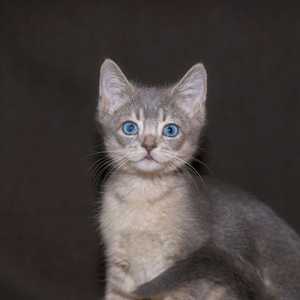
- Shortcut:
- ALT
- Group:
- Shorthair
- Сategory:
- Primary
- Origin:
- Russia
- Recommended for:
- families with children; for active, energetic people; for those seeking a unique breed with a mesmerizing gaze; for living both in apartments and private homes.
Breed History
It happened! On November 3, 2025, in Murmansk, at the international cat show under the TopCat system, the "Altai Blue-Eyed" breed changed its status — from Experimental to Fundamental! This event is the result of many years of meticulous work by enthusiasts who fought for nearly three decades for recognition of this unique native breed.
The history of the Altai Blue-Eyed begins in the mid-1990s in Ust-Kamenogorsk. Lyubov Borisovna Zikeeva saw a cat with extraordinary blue eyes at her acquaintance Vera Vasilievna Sokolova's home. His name was Fyodor. Fyodor's coat was black with white, with point spotting on his paws and tail, and his eyes were bright blue. He closely resembled those Californian cats that Olga Sergeevna Mironova spoke about at felinology courses in Novosibirsk.
Fyodor was already 14 years old, but that did not prevent him from becoming a father. In an accidental mating with a white cat, a female kitten named Pani was born — with the same coat pattern and blue eyes as her father. It was Pani who became the progenitor of the Altai Blue-Eyed cats. She produced kittens with a clear coat pattern, a white tail tip, and blue eyes. The first such female kitten from Pani was named Ariel.
Lyubov Borisovna informed Olga Sergeevna Mironova of her achievements, and she helped register the breed in the registry of indigenous breeds of the Russian SFF under No. 10 (October 1999) with a preliminary standard, and also advised working on reducing the amount of white while preserving eye color. Through inbreeding and line breeding, Lyubov Borisovna achieved her goal.
First, she worked on solid colors, then gradually introduced tabby patterns. She became a pioneer in working with this new variety of cats, the first breeder and owner of the first Altai Blue-Eyed cattery — "Darlin".
Zikeeva devoted 20 years of her life to this work, but due to age and declining health, she could not bring the work to its logical conclusion. However, in 2014, Lyubov Borisovna gained a successor — Nadezhda Bagina (cattery "Siyanie Severa", Murmansk). Nadezhda acquired two odd-eyed cats from Zikeeva — a male, Trifan Darlin, and a female, Stesha Darlin — and promised to complete the work and register the breed. She kept her word. Another 11 years of work continued, and on November 3, 2025, at the TopCat show in Murmansk, with the support of Anna Anatolyevna Rudakova, the breed was officially registered as Fundamental.
Appearance
The Altai Blue-Eyed Shorthair belongs to the shorthair group. It is a medium-sized cat, with a flexible yet strong body and well-developed musculature. Weight ranges from 2.5 to 4.5 kg. Males are slightly larger than females.
Standard — Point Scale (TOPCAT):
| Parameter | Points |
|---|---|
| Body | 20 |
| — size and boning | 6 |
| — torso | 7 |
| — neck | 2 |
| — legs and paws | 5 |
| Head | 25 |
| — shape | 8 |
| — muzzle and chin | 7 |
| — profile | 10 |
| Eyes | 20 |
| Ears | 10 |
| Tail | 5 |
| Coat | 15 |
| — length and type | 5 |
| — texture | 5 |
| — color | 5 |
| Condition | 5 |
| Total | 100 |
Torso: Moderately elongated, rectangular in format.
Neck: Strong, medium size.
Legs and paws: Strong limbs, medium length, hind legs slightly higher than front legs. Paws oval.
Head: Rounded wedge shape, with prominent cheekbones and full cheeks. The forehead, curving backward, transitions into a flat skull. Muzzle not long, with a well-rounded chin. Nose straight, broad, the transition from forehead to nose is smooth and clearly noticeable. Scissor bite.
Eyes: Large, wide-set and slightly oblique, rounded in shape (resembling a nut). Color — from bright blue to dark blue, or odd-eyed. Sectoral (partial) heterochromia is not permitted.
Ears: Medium or larger than medium size with rounded tips, broad at the base.
Tail: Medium length or longer.
Coat: Short, dense, resilient, smooth, glossy with a well-developed undercoat.
Colors: All colors with white and point spotting; a pattern without white is possible. Pure white and color-point colors are not permitted. The main breed-defining feature is blue or odd eyes in any color except white and point, with possible small white patches.
Breed faults: Long narrow head; sectoral heterochromia; insufficient muscle tone; short tail.
Disqualification: Extensive baldness; abnormal or kinked tail; incorrect number of toes; cross-eyes; weak hind legs; any signs of illness or unhealthiness.
Personality and Character
The Altai Blue-Eyed is an amazingly kind and affectionate cat. They are so trusting that they love to lie on their backs, demonstrating complete trust in their owner. This may be a unique feature of this breed.
The cat is balanced, gentle, and shows no aggression. Very active, lively, playful. Adores children — an excellent family companion. Gets along well with other animals. Possesses high intelligence. Feels equally at home in an apartment or a private house; can do without walks, but can also travel the world with its owner — easily adapting to new environments.
Care and Maintenance
The Altai Blue-Eyed Shorthair is extremely undemanding in terms of care.
- Coat: Brushing once or twice a week is sufficient, except during shedding periods when daily brushing is necessary.
- Hygiene: Control of the cat's teeth, eyes, and ears is necessary, which can be done once a week.
- Bathing: As needed, before shows.
Nutrition
A balanced diet — super-premium food or high-quality natural feeding (meat, organ meats, vegetables, vitamins).
Health
The breed has good health. Life expectancy — up to 20 years.
Breeding and Genetics
The key feature of the breed is the blue-eye gene Altai Dominant Blue Eye (DBE*ALT), which:
- Is dominant, but with incomplete penetrance (not all carriers show the phenotype);
- Can produce latents — cats carrying the blue-eye gene but without blue eye color;
- Requires careful breeding: mating two blue-eyed or odd-eyed cats is not recommended due to not fully understood consequences. Matings between blue-eyed cats and green-eyed or yellow-eyed representatives of the breed are recommended.
Permissible outcrosses:
- Only with Altai Blue-Eyed cats (latents) that have non-blue eyes.
- A one-time outcross with a domestic cat is permitted.
Color codes (heterochromia and latents) in the TOPCAT system:
| Code | Description |
|---|---|
| 68 | blue eyes in all DBE |
| 68a | odd eyes, where the non-blue eye is green |
| 68b | odd eyes, where the non-blue eye is yellow |
| 68c | odd-eyed latent (green and yellow) |
| 68d | green-eyed latent |
| 68e | yellow-eyed latent |
| 68f | blue eyes with sectoral heterochromia (incomplete iris pigmentation on both eyes) |
| 68g | odd eyes with sectoral heterochromia (incomplete pigmentation on one eye) |
| 08 | residual white (dominant white spotting) |
Important: Sectoral heterochromia in cats can be inherited. Animals with this feature are not permitted for breeding but may participate in shows in the neuter class.
Breed designation by coat length:
- ALT — shorthair
- ALL — longhair
Current Status and Science
Science has now advanced, and the Altai Blue-Eyed gene can now be identified through genetic testing. In 2024, three publications were released by authors from scientific laboratories in France, Germany, Switzerland, and the USA, investigating variants of the PAX3 gene leading to dominant blue eye (DBE). One of the mutations characterizes precisely the Altai Blue-Eyed cats. The allele has been named DBE*ALT (Altai Dominant Blue Eye).
Link to publication: https://www.ncbi.nlm.nih.gov/pmc/articles/PMC11240321/pdf/animals-14-01845.pdf
As Nadezhda Bagina noted, summarizing her 11 years of work: "I understand that this breed will be searching for its admirers for many years to come. But still, I am happy that it is registered! I am grateful to Anna Anatolyevna Rudakova and TOP CAT for giving the Altai Blue-Eyed another chance to become a Fundamental — recognized breed."
Photos for the article provided by the cattery
"Siyanie Severa" (Murmansk), owner — Nadezhda Bagina.