
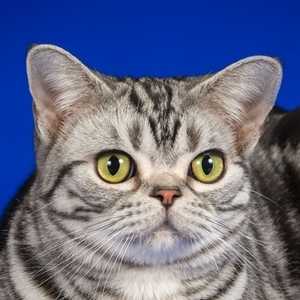
- Shortcut:
- ASH
- Group:
- Shorthair
- Сategory:
- Primary
- Origin:
- USA
- Recommended for:
- families with children; for calm, balanced people; for those seeking an unpretentious, healthy breed; for living both in apartments and private homes.
Origin of the breed:
Breed History
There is a beautiful legend that Christopher Columbus, setting out to conquer America, took a pair of cats on each of his ships to protect against mice. According to the legend, the ancestors of American Shorthair cats arrived on this continent in such a romantic manner as early as the 15th century. Another version suggests that the first cats of the New World arrived somewhat later — in 1620, with the first group of English Puritans who settled in America.
Whichever way these animals ended up overseas, the need to adapt to new living conditions made their coats thicker and harsher, and they grew larger than their European ancestors. In America, this cat could be found everywhere — on ranches, farms, near houses or barns — where it tirelessly fought mice and other rodents. Living in natural conditions, it acquired the traits of a strong, stable, and healthy breed.
The documented history of the breed begins only at the beginning of the 20th century. In 1904, the Cat Fanciers' Association (CFA) registered a black smoke cat named Buster Brown, whose pedigree traced back to British Shorthair cats. The crossing of British cats and other breeds with ordinary domestic street cats gave rise to the American Shorthair breed (originally called the Domestic Shorthair).
In 1950, the CFA published the first stud book of Domestic Shorthairs, which included 50 representatives of the new breed. Under this name, these cats first appeared at shows in 1966. In the CFA, cats that externally met the American Shorthair standard were registered as Domestic Shorthairs until 1985.
A true victory for breed enthusiasts was the CFA's highest title, "Cat of the Year," awarded in 1966 to a gorgeous classic brown tabby cat named Shawnee Trademark. A cat named Hedgewood's Great American Hero (Mr. H to his friends) received the same high title in 1984, and Saur-Mer Sharif in 1996.
Appearance
The general impression should be that of a strongly built, well-balanced, symmetrical cat with conformation indicating power, endurance, and agility. An animal of medium to large size, weight ranges from 3.5 to 7 kg. The build is powerful, even somewhat robust, with strong bone structure. Males are noticeably larger than females (pronounced sexual dimorphism).
Standard — Point Scale (TOPCAT):
| Parameter | Points |
|---|---|
| Head (shape, muzzle & chin, profile) | 30 |
| Eyes | 5 |
| Ears | 5 |
| Body (size & boning, torso, neck, legs & paws) | 30 |
| Tail | 5 |
| Coat (length, texture, color) | 20 |
| Condition | 5 |
| Total | 100 |
Head (30 points):
- Shape (10 points): The broad head gives a rounded impression, but it is slightly longer than broad. Top of head is rounded in profile, but not domed.
- Muzzle and chin (10 points): The nose is of medium length and broad. The muzzle is massive, with square contours and clearly defined with a slight whisker break. The chin is full and strong.
- Profile (10 points): The profile is clearly curved, with a moderate stop.
Eyes (5 points): Large and wide-set, with the upper lid shaped like half an almond (cut lengthwise) and the lower lid shaped in a fully rounded curve. At least the width of one eye between eyes. Outer corners set very slightly higher than inner corners. Eye color corresponds to coat color. Clarity of color is desirable.
Ears (5 points): Medium-sized with slightly rounded tips, which may have tufts. They are wide-set but not very open at the base.
Neck (4 points): Medium short, muscular and solid.
Body (30 points):
- Size and boning (10 points): Medium to large in size with quite heavy boning. Females can be proportionately smaller.
- Torso (8 points): Rectangular format. The rib cage is round and well developed. The torso is rounded and of even width, with a level back.
- Legs and paws (8 points): Medium length, with solid muscles. Paws are firm and rounded.
Tail (5 points): Of medium length in proportion to the body; it tapers slightly from a broad base to a rounded tip. Carried at the level of the back, kinks are not permitted.
Coat (20 points):
- Length (5 points): Short.
- Texture (10 points): Dense, firm, and glossy, close-lying with sufficient undercoat. In winter, the undercoat becomes thicker.
- Color (5 points): Colors not belonging to the original gene pool (chocolate, lilac, cinnamon, fawn, caramel, colorpoint, sepia, and mink colors, as well as their combinations with white) are not recognized. All other colors and patterns are recognized. Any amount of white is permitted.
Condition (5 points): Excellent physical condition, glossy coat, clean eyes and ears, good muscle tone.
Special Breed Faults
- Low, flat forehead
- Heavy, protruding eyebrow ridges
- Too big, too round, or deep-set eyes
- Long, pointed ears or ears set too close together
- Too short and thick or too long and slender neck
- Whip-like tail, too short and thick tail, or tail carried over the back in a squirrel fashion
Without Certificates
- Fine boning
- Long or narrow head
- Long Roman nose
- Thin muzzle
Disqualification
- White buttons or lockets
- Long hair
- Amputated claws
- Cryptorchidism
- Deafness
- Noticeable bone deformities
Personality and Character
The American Shorthair matches its harmonious appearance: this cat is moderately active, balanced, calm, has an easy-going personality, and is particularly devoted to its owner. Not aggressive, rarely acts unpredictably. Sociable and independent, it easily adapts to any living conditions and environment — people, other animals, birds. Tolerates travel well. This cat is easy to train, as it has an obedient disposition and is intelligent. Somewhat lazy and sedentary: it likes to lie around, which can lead to obesity. Sexual maturity occurs early — at 7-8 months.
Care and Maintenance
Care for the American Shorthair is minimal.
- Coat: Weekly brushing with a rubber brush is sufficient. During shedding periods, the cat should be brushed daily.
- Bathing: If the cat has access to the outdoors, or before participating in shows, the animal should be bathed.
- Hygiene: Regular checking of ears and eyes, nail trimming as needed.
Nutrition
A balanced diet and strict control over the quantity and quality of food are necessary, as these cats are prone to overeating and, consequently, obesity. Super-premium food for active breeds or a high-quality natural diet is recommended.
Health
American Shorthair cats are known for their robust health, as the breed developed in natural conditions. However, the following issues are possible:
- Hypertrophic cardiomyopathy (HCM) — a hereditary heart disease
- Obesity — from overfeeding and lack of exercise
Life expectancy: 15–20 years.
Breeding
Permissible outcrosses (in the TOPCAT system):
- American Wirehair
Important: Outcrossing with other breeds is not permitted.
Breeds Created Using American Shorthair Cats
- American Wirehair — arose as a spontaneous mutation in an ASH litter
Other and Obsolete Breed Names
- Domestic Shorthair
- American Kurzhaar
Unofficial (Slang) Names
Kurzhaar. American.